 Skip to main content
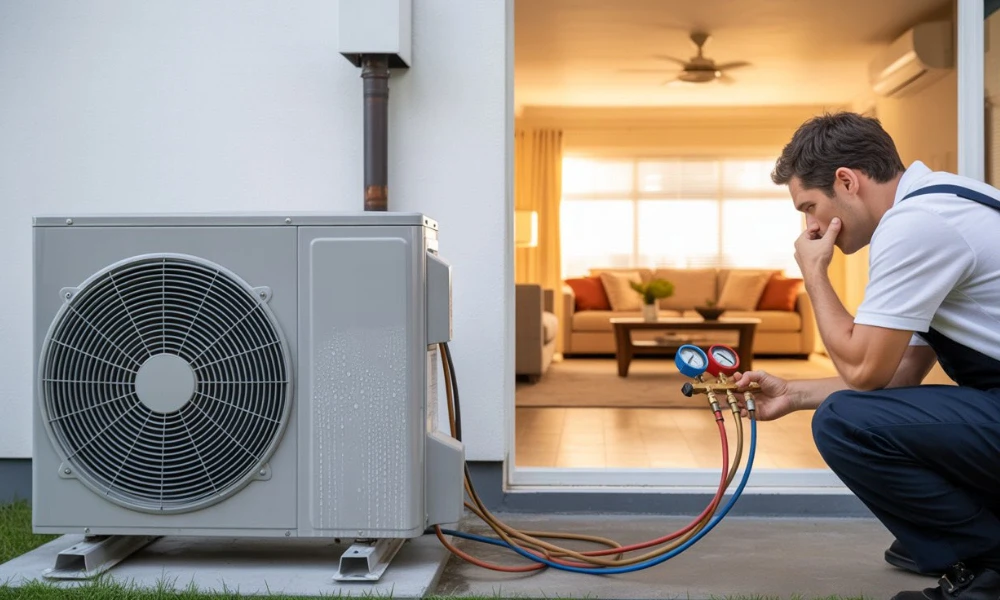
When your air conditioner is running but not blowing cold air, it can make your Dallas home too warm. At Lee Air Services, we frequently find simple causes, such as a dirty air filter or incorrect thermostat settings, but it can also be more serious, such as low refrigerant, frozen coils, or compressor trouble. Ideally, your air conditioner should cool indoor air to about 15-20°F below the outside temperature. If it isn’t, something’s wrong. Today, we’ll help you figure out what’s wrong, when to try quick DIY fixes, and when to call a professional technician.
Key Takeaways
|
Should You Turn Off Your AC Right Now? (Quick Safety Check)
Before you begin troubleshooting, make sure your air conditioner is safe to keep running. Some warning signs indicate that you should turn off your AC immediately to avoid serious system damage or electrical hazards.
Turn OFF Immediately If You See or Hear:
- Ice accumulates on the indoor unit or copper refrigerant lines. Allow the system to thaw before restarting.
- A burning odor or any smoke. This could indicate an electrical problem.
- Grinding, screeching, or loud banging sounds. This may cause compressor or fan damage.
- Water leaks or pools around the indoor unit. Water damage can occur from a clogged drain line.
- The circuit breaker went off more than twice. This is a clear indication of an electrical fault.
Safe to Keep Running While Troubleshooting:
- The air is warm, but there are no unusual smells or sounds.
- The air conditioner is constantly running, but it is only slightly cooling.
- There are no visible ice or water leaks.
- The problem is limited to thermostat settings or a dirty air filter.
At Lee Air Services, we always recommend turning off the system at the first sign of trouble to protect both your AC and your home.
How to Reset Your AC When It’s Not Blowing Cold Air
Sometimes all it takes to get your system cooling back on track is a fast reset. Like any electronic device, your air conditioner can experience minor control glitches or power outages that prevent it from blowing cold air.
What Does Resetting Actually Do?
When you reset your AC system, you’re giving the control board and communication sensors a fresh start. This process clears minor electronic errors between the thermostat and other components.
Step-by-Step Reset Instructions
- Turn off the AC at the thermostat.
- Find your circuit breaker panel, which is usually located in the garage or basement.
- Find the breaker marked “AC,” “Air Conditioner,” “HVAC,” or “Cooling.”
- Wait 30-60 seconds for capacitors to fully discharge.
- Turn the breaker on again.
- Allow 5 minutes for the system to stabilize.
- Switch the thermostat to Cool mode.
- Lower the temperature by about 5 degrees Fahrenheit below the room temperature.
- Wait for the outdoor unit to turn on after 3-5 minutes.
- Check your vents after 10-15 minutes to see if airflow and cold air are restored.
When Resetting Works (and When It Doesn’t)
A reset frequently resolves thermostat communication problems, temporary control board glitches, and minor sensor faults. However, it does not address refrigerant leaks, compressor failure, dirty coils, or other mechanical issues. If your air conditioner is running but not blowing cold after a proper reset, call Lee Air Services for a professional HVAC inspection before restarting it.
9 Common Reasons Your AC Is Running But Not Cooling
A central air conditioner running but not blowing cold air is one of the most frequent problems that Dallas homeowners face, especially in the summer. At Lee Air Services, we discovered that thermostat, air filter, and refrigerant issues account for nearly 60% of all cooling issues we diagnose.
Some of these issues are simple to fix at home, while others necessitate the assistance of a professional to avoid further system damage. We’ll go over 9 possible causes, beginning with the most common and easiest to fix.
1. Thermostat Issues or Incorrect Settings
If the thermostat is not properly set or is malfunctioning, your AC may run without producing any cold air. Small adjustments to the settings can have a significant impact on temperature and comfort.
- Check Mode: Cool vs. Fan vs. Heat
Make sure your thermostat is set to Cool mode, not Fan or Heat. The Fan mode only circulates air without cooling, while Cool activates the compressor for proper operation.
- AUTO vs. ON Settings (Fan Behavior)
When the fan is turned on, it runs continuously, even between cycles, which can make the air feel warm. Choose AUTO to ensure that the fan only runs during cooling cycles, resulting in consistently cold air.
- Temperature Settings Verification
If the temperature is set too close to your current room temperature, you will only feel a slight cooling effect. To begin a full cooling cycle, lower the temperature by at least 5°F. Remember, a normal temperature differential should be 15-20°F lower than the air being drawn in.
- Thermostat Positioning Issues
Poor placement near a window, lamp, or other heat source can result in false readings, causing your system to run incorrectly. Placing the thermostat on a central, shaded wall ensures accurate readings.
- Battery check
Replace the batteries if the thermostat’s display goes blank or becomes unresponsive. Weak batteries frequently disrupt communication with your AC, preventing it from initiating cooling cycles.
2. Dirty or Clogged Air Filter
When your air filter becomes clogged with dust, debris, pollen, or pet dander, airflow through your system is restricted, requiring your AC to work much harder to maintain proper cooling.
Over time, this strain can cause the evaporator coil to get frozen, leading to weak airflow or even complete cooling failure. A dirty air filter reduces comfort, reduces efficiency, and raises energy bills.
How Often to Change Filters
Most homeowners should change their filters every 1-3 months. If you have pets or allergies, make monthly changes to avoid blockages. Regular replacement ensures that airflow is consistent and your system performs optimally.
How Dirty Filters and Frozen Coils Cause No Cooling Issues
When the filter is clogged, airflow decreases, and the evaporator coil can freeze. This ice buildup completely blocks airflow, preventing your AC from cooling.
3. Low Refrigerant or Refrigerant Leak (Low Freon)
One of the most frequent reasons an AC system fails to cool is low refrigerant levels. Unlike fuel, refrigerant (or Freon) circulates within a closed system. So, if your AC is running low on refrigerant, there is a leak somewhere.
A refrigerant leak not only reduces performance but can also cause ice buildup on copper lines, forcing your compressor to work continuously without effectively cooling your home.
How to Check If Your AC Needs Freon (DIY Signs)
While you can’t measure exact refrigerant levels without special gauges, you can look for warning signs:
- Ice or frost on copper refrigerant lines outside.
- Ice is forming on the indoor evaporator coil.
- The air conditioner runs constantly, but it barely cools the room.
- Hissing or bubbling sounds near the lines (indicate an active leak)
- Higher-than-average energy bills
- Room temperature takes longer to drop.
Why You Can’t DIY Refrigerant Issues
Only EPA-certified HVAC technicians are permitted to repair refrigerant leaks or recharge them because freon can be toxic if not handled properly. When you contact Lee Air Services, our HVAC technicians will inspect for refrigerant leaks, repair the damage, and recharge the system to proper pressure. This ensures that your cooling system operates safely and efficiently.
4. Dirty or Blocked Condenser Coils (Outdoor Unit)
Your condenser coil helps your AC’s cooling process by releasing heat that has been absorbed indoors. When the outdoor unit becomes dirty or covered in debris, the heat cannot escape efficiently. The compressor then has to work harder, decreasing efficiency and increasing energy consumption.
How to Clean Your Condenser Safely
- Turn the power off at the disconnect box near the outdoor unit.
- Remove visible debris (leaves, grass, and sticks) by hand.
- Keep a minimum of two feet between you and the unit.
- Gently clean the condenser coils from the inside out using a garden hose.
- Straighten bent fins with a fin comb, if available.
- Allow the unit to completely dry before turning the power back on.
The worst seasons for buildup are spring (pollen and cottonwood) and fall (leaves and dust). After heavy winds or storms, always check your outdoor unit for blockages.
5. Faulty or Failing Compressor
Last year, the same problem occurred: my air conditioner was running but not blowing cold air. After inspecting, I found out it’s the compressor of my AC system. The compressor is mainly responsible for pressurizing refrigerant and driving the cooling cycle.
When it fails, your outdoor unit may still run, but there’s little or no cooling indoors. A faulty compressor may cause the air conditioner to run but not produce cold air.
Our HVAC technician can measure amp draw and test electrical connections to confirm the issue. Sometimes, what seems like a compressor failure is actually a bad capacitor, which is a much cheaper repair.
How to Tell If Your Compressor Is Bad
Listen for These Sounds:
- Clicking: Compressor struggling to start
- Humming: Trying to engage, possibly capacitor issue
- Grinding: Internal damage, likely failure
- Silent outdoor unit: No activity = possible electrical or compressor failure
Check Visually:
- The outdoor unit fan runs but compressor doesn’t
- The circuit breaker trips when cooling starts
- No vibration or sound from outdoor unit
When You Need Repair vs. Replacement
If your compressor is dead and the system is old, a new unit may be the better investment. A modern replacement improves cooling efficiency, reliability, and warranty coverage, saving you money in the long run.
6. Blocked or Malfunctioning Blower Fan
A blower fan plays a key role in air circulation, pushing cooled air through the vents and keeping your home comfortable. When the blower fan fails or becomes blocked, your AC may run but won’t deliver proper airflow, making it seem like the home air conditioner is not blowing cold air but running.
A malfunctioning blower fan means cold air can’t move from the indoor unit to your living spaces. Dirty fan blades often cause weak airflow and force the fan motor to work harder, reducing efficiency.
If you feel air during heating but not cooling, the blower fan is likely fine, the issue could be with your compressor or refrigerant system.
A quick inspection by our Lee Air Service’s HVAC technicians can pinpoint the issue and restore proper air circulation for consistent cooling.
7. Clogged Condensate Drain Line
A clogged condensate drain line is one of the most common causes of water dripping from your indoor unit. Your AC constantly removes humidity from the air, turning it into condensate water that should flow through the drain line to the outside.
When algae, mold, or debris builds up inside, it blocks the line, causing water backup and potential overflow in the drain pan.
Most modern systems include a safety float switch that detects overflow and triggers an automatic shutdown to prevent water damage. This is why your AC might suddenly stop cooling while the fan still runs.
Why Do You Need Professional Drain Line Service
An HVAC technician can clear the drain line, flush it with water or cleaning solution, and apply algae prevention treatments to stop future clogs. Regular maintenance helps keep your AC running safely and efficiently.
8. Electrical Issues or Tripped Circuit Breaker
Electrical issues are another common reason your AC system stops cooling. A tripped circuit breaker cuts power to protect your home from overload or short circuits. When this happens, your outdoor unit or compressor may stop running entirely, leaving the indoor fan blowing warm air.
If the breaker trips once, it might be a simple surge. But repeatedly tripping breakers points to deeper electrical issues like bad wiring, a weak capacitor, or a failing compressor. Ignoring this can cause damage or even create a fire hazard.
When to Call an Electrician vs. HVAC Tech
If the breaker itself or wiring is damaged, call an electrician. For capacitor, contactor, or compressor faults, our Lee Air Service’s licensed HVAC technician can inspect and repair the system safely.
9. Leaky or Poorly Insulated Ductwork
Leaky or poorly insulated ductwork can make your AC work overtime without properly cooling your rooms. When ducts have leaks or gaps, a large amount of cold air escapes into the attic or crawl space instead of reaching your rooms.
This leads to uneven cooling, poor airflow, and higher energy bills. In some homes, 20-30% of cooling efficiency is lost due to leaking ducts.
Ducts running through unconditioned spaces lose cold air quickly, especially if insulation is thin or damaged. That’s why duct sealing and insulation are critical for maintaining consistent temperatures and system efficiency. Properly insulated ducts ensure cold air stays cold until it reaches your vents, improving comfort and reducing AC strain.
Where Do Duct Leaks Happen?
Leaks frequently occur at register boot connections, duct-to-duct joints, and attic ductwork seams. These spots are prone to separation due to vibration or aging materials.
Could AC Performance in Extreme Heat (90°F+) Cause Cooling Issues?
When the temperature reaches 90 degrees or higher, even a healthy air conditioner may appear to struggle. In extreme heat, your AC must work at full capacity to keep your home comfortable, often running continuously to maintain the indoor temperature.
Continuous operation in extreme heat is normal, but it also highlights potential problems such as poor insulation, excessive heat gain, or an undersized system. If your air conditioner runs constantly but doesn’t lower the indoor temperature, it may not have enough BTU capacity for your space.
When Constant Running Indicates a Problem
- AC runs constantly but indoor temperature stays above 80°F
- Cooling issues appeared recently, not in prior summers
- Similar homes stay cooler in the same weather
- You’ve remodeled or changed insulation levels
- New system but performance feels weak
How to Do Your Own Troubleshooting: First Things to Try
If your air conditioner suddenly stops working, a few DIY troubleshooting steps can help you find and fix simple AC problems before calling a technician.
Many minor issues, such as incorrect thermostat settings, a clogged filter, or a tripped breaker, can be easily resolved without the need for tools or technical knowledge.
Start by checking your thermostat settings and ensuring that the system has enough airflow. It’s also a good idea to give your outdoor unit a quick visual check to make sure the breaker hasn’t tripped.
For a detailed, step-by-step checklist on DIY troubleshooting, [click here] see our full guide on AC troubleshooting tips.
Conclusion
When your central air conditioner is not blowing cold air but still running, the solution can range from a simple thermostat adjustment to a major system repair. Check the basics first, such as filters, breakers, and thermostat settings, to see if you can solve the problem on your own.
However, if refrigerant leaks, electrical issues, or compressor failures are present, it is time to contact Lee Air Services‘ licensed HVAC technicians. Our maintenance plan, which includes annual tune-ups and filter replacements, keeps your system running smoothly, avoids breakdowns, and safeguards your investment for years to come.
FAQs
Can I recharge my AC refrigerant myself?
No, only EPA-certified HVAC technicians can legally handle refrigerant, as low refrigerant means a leak that requires professional detection and repair before recharging.
Is it normal for my AC to drip water outside?
Yes, normal condensation drains outside through the PVC line, but indoor water pooling indicates a clogged drain line that needs immediate service.
Can I run my AC with a dirty filter temporarily?
No, running an AC with a dirty filter restricts airflow, causes frozen coils, and can damage the compressor, turn it off until the filter is replaced.
Why doesn’t my AC work, but the fan and heat do?
If your fan and heat still work but the cooling does not, the AC compressor or its electrical circuit has most likely failed, preventing the refrigerant cycle from starting even if the blower and heat relay continue to function.
