


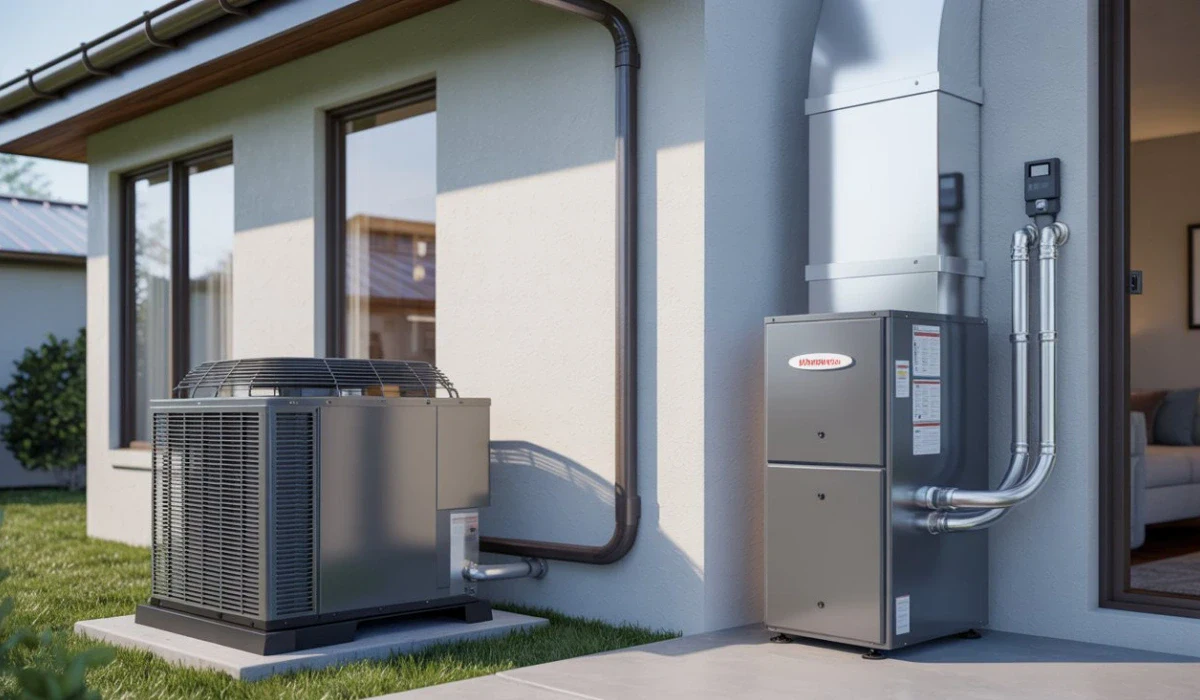
Buying a new HVAC system is one of the most important decisions for your home’s comfort and energy efficiency. Whether your air conditioner keeps breaking down or you’re planning an upgrade before the next Texas summer hits, this guide will help you make a confident, informed decision.
We’ll cover when to repair vs. replace, financing your investment, sizing your system correctly, and choosing the right contractor for installation and maintenance, ensuring your HVAC system performs efficiently for years.
Key Takeaways
|
The Decision Point: Repair, Replace, and Finance
When to Replace: Applying the $5,000 Rule and Age Check
Many homeowners ask online, “Should I repair my HVAC or replace it?” The $5,000 Rule provides a quick decision tool for replacement.
How the $5,000 Rule Works (Age × Repair Cost)
Take the age of your system and multiply it by the repair cost. If the total exceeds $5,000, replacement is usually the smarter financial move.
For example, a 12-year-old AC needing a $500 repair equals $6,000. That’s above the threshold, time to start shopping for a new system. This simple calculation helps homeowners make confident, informed choices without overthinking.
Other Must-Replace Indicators
- The R-22 & R-410A Crisis: R-22 production ended in 2020, and R-410A, used in most systems since 2010, is being phased out in new equipment starting 2025. Upgrading ensures your system uses low-GWP refrigerants like R-454B, providing better long-term service.
- Frequent Breakdowns: Constant service calls indicate your system is becoming a money pit rather than a reliable comfort source.
- System Lifespan: ACs last 10–15 years, furnaces 15–20 years. Nearing those ages, efficiency drops and repair costs rise.
Financing Your Investment: Rebates, Loans, and Savings
1. Navigating HVAC Financing Options
Replacing your HVAC system doesn’t have to drain savings. Many contractors, including Lee Air Services, offer financing options. Know the difference between True 0% APR (no interest ever) and Deferred Interest (interest retroactively applied if the balance isn’t paid in full).
Secured loans like a Home Equity Line of Credit (HELOC) often provide lower rates, while unsecured personal loans are faster but usually cost more.
2. Federal and Local Incentives (The ROI)
You may qualify for federal tax credits (like the Inflation Reduction Act’s heat pump credits) or local utility rebates. These incentives can lower upfront costs and improve your return on investment while reducing monthly energy bills.
The Critical Factor: Sizing and Performance
- Sizing: Why the Manual J Calculation is Non-Negotiable
Homeowners often ask, “What size HVAC system do I need?” A Manual J calculation determines the perfect system for your home based on square footage, insulation, windows, and local climate.
The Double Danger of an Incorrect Size
- Oversizing: Cools or heats too quickly, causing short-cycling, high humidity, and wear-and-tear.
- Undersizing: Runs constantly, fails to meet demand, and shortens lifespan.
Key Factors in a Load Calculation
A professional from Lee Air Services considers:
- Insulation levels and window quality
- Air infiltration through cracks or ducts
- Ductwork integrity; leaks or poor design cause efficiency losses
- Efficiency Ratings: SEER2, AFUE, and EER2
- SEER2: Cooling efficiency
- AFUE: Furnace efficiency
- EER2: Real-world performance in hot climates
Higher SEER2 or EER2 ratings save energy and reduce bills. Texas minimums are 14.3 SEER2 and required EER2 ratings reflect peak performance standards.
Equipment Types and Smart Technology
Choosing Your System Type: Stages and Features
Options include single-stage, two-stage, and variable-speed units.
- Single-Stage: Basic on/off operation
- Two-Stage: Two output levels for comfort
- Variable-Speed: Continuously adjusts output, balancing comfort and humidity
Variable-speed compressors run quieter, save energy, and maintain steady indoor conditions.
Indoor Air Quality (IAQ) and Add-Ons
Consider whole-home humidifiers, dehumidifiers, and advanced filtration to reduce allergens, dust, and humidity, especially in Texas’s variable climate.
Smart Thermostats: The Key to Optimized Performance
Smart thermostats integrate with your smart home devices, letting you schedule temperatures, monitor bills, and adjust settings remotely. They typically pay for themselves in a few years through energy savings.
Vetting the Contractor and Installation
The Contractor Checklist: Avoiding Red Flags
Installation quality often determines system performance. Even the best brands underperform if installed poorly. Always request multiple quotes and detailed explanations from professionals like Lee Air Services.
Three Questions Every Homeowner Must Ask
- “Can you show me the Manual J calculation?”
- “What’s the AHRI Match Certificate number?”
- “What are the full equipment and labor warranties?”
The Truth About Brands
Top brands (Trane, Carrier, Goodman, Lennox) are reliable when installed correctly. Focus on contractor skill, warranty coverage, and reputation, not just the nameplate.
Protecting Your Investment: Warranty, Maintenance, and DIY Limits
Register your system online to activate full warranty. Twice-yearly maintenance keeps coverage valid. DIY installation voids warranties and is illegal under EPA Section 608. Trust Lee Air Services for professional, safe installation.
Final Thoughts
Buying a new HVAC system doesn’t have to be overwhelming. Understanding the $5,000 rule, Manual J sizing, and the value of expert installation and maintenance empowers you to make confident, cost-effective decisions.
At Lee Air Services, we help you select and install the perfect HVAC system, efficient, reliable, and built to provide years of comfort.
FAQs
How much does a new HVAC system installation cost?
Typically $7,500–$12,500, depending on system size, brand, and efficiency.
Is one HVAC brand better than others?
No, installation quality and proper sizing matter far more.
What is an AHRI certification?
It verifies indoor and outdoor components are properly matched and meet efficiency standards.
What ratings matter most for furnaces?
AFUE, higher percentages indicate more efficient fuel-to-heat conversion.
What is a variable-speed HVAC system?
It adjusts output in small increments, maintaining comfort, humidity control, and efficiency.
